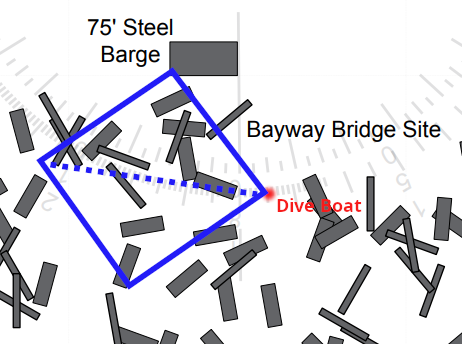
Imagine you are diving with a buddy on South County Reef off St Petersburg, Florida.
It is a perfect spring day – light wind, flat seas, no current, and forty feet of visibility. As you and your buddy plan the dive, you decide to navigate using a square pattern: you will swim north-north-west (330 degrees) from the anchor line to the barge, and then swim the rest of the square. You jump in, count 30 kick cycles to the wreck, check it out, and then continue over the rest of the bridge debris as planned.
You are at the second waypoint when your buddy signals that he is cold and wants to go back to the boat. Which direction is the boat? How many kick cycles?
This is the half-square triangle, a return along the diagonal, and it is one of the most useful scuba compass patterns.

The trick is to realize you just go “half again” on the second turn. Here is how that works:
The initial heading was 330. Since I know not to do math underwater, I computed the other two legs ahead of time (or I just looked at my compass for the right angles). 330 to 240 to 150 to 60. So, the second turn should have taken me from 240 to 150. Now, I go “half again,” or another 45 degrees… and the correct heading back to the boat is 150 – 45 = 105.
What about the distance? Well, if I am on the surface using a calculator, I would use the most famous theorem in mathematics to tell me 30² + 30² = c², implying c = √1800 ≈ 42, which is a little difficult to compute without a calculator under narcosis. However, the two sides are equal, which means I can do a little trick to figure it out quickly.
Looking again at the Pythagorean Theorem, I have a² + b² = c². Knowing a and b are equal, I can rewrite that as a²+a²=c², or 2a² = c². Taking the square root of both sides, I find √2 · a = c. The square root of two is 1.41… which is close enough to 1.5 for scuba work. So, if I multiply my initial leg by 1.5, or take “half again,” I find an approximate distance.
In this scenario, I would estimate 30 + 15 = 45 kick cycles back to the boat, which is close enough to find the anchor line.
Hence, the half-again triangle. I move my compass “half again” from my 90 degree turn, and I swim “half again” the distance.
Another example: I am navigating a right-turning square this time, beginning at 100 degrees. My planned turns would be 100 to 190, 190 to 280, and 280 to 10 (280+90-360=10). My distance was 15 kick cycles. I abort on the second turn, so I would turn to 280, and then keep turning another 45 degrees to 325. Since I went 15 kick cycles for the two legs, I would expect to go 14+7 = 22 kick cycles back to the start. (I changed 15 to 14, so it would be easy to half, and since the square root of two is slightly less than 1.5.)
Try it yourself. Your initial heading is 20 degrees, you are turning to the right, and moving 20 kick cycles. Answer1
Try another: Initial heading is 20 degrees, but turn left this time (subtract). Go 25 kick cycles. Answer2
If you want to do the Navigation Course with me, contact Adventure Outfitters and let’s do it!